 English
 简体中文
简体中文
 عربي
عربي
 Русский
 Français
 Español
Tracked Mobile Cone Crushers: Flexible Aggregate Production Anywhere
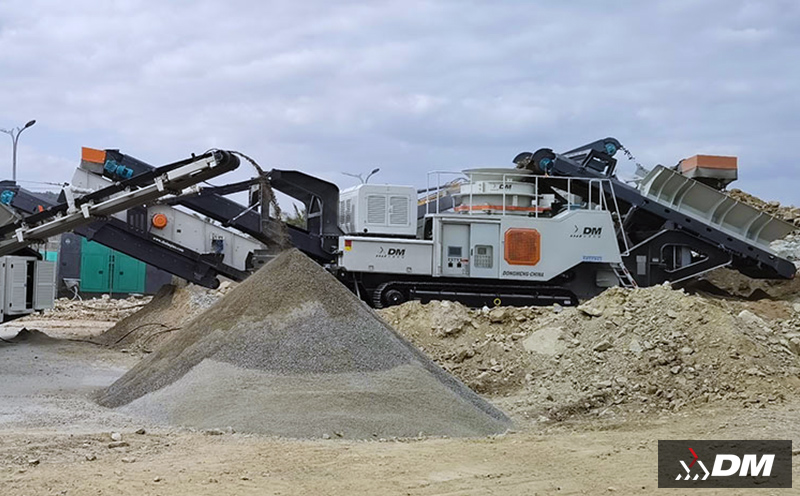
Aggregate production used to mean a fixed plant in a permanent location. Material came to the crusher by the truckload, was processed through a series of stationary machines, and left as finished product. But today's construction market is different. Projects are spread out, job sites move, and contractors need to produce spec-grade aggregate wherever the work is. Road builders, civil contractors, quarry operators with satellite pits, and mining service companies all face the same challenge: how to get high-quality secondary and tertiary crushing capability without building a permanent plant at every location. The answer is the tracked mobile cone crusher. Mounted on a heavy-duty crawler undercarriage and powered by an onboard diesel engine, a mobile cone brings the precision and performance of a stationary cone crusher to any job site, any pit, and any temporary stockpile. When paired with a tracked mobile jaw crusher for primary reduction and a tracked mobile screening machine for sizing, it forms a complete portable crushing train that produces finished aggregate on demand.
The Challenges of Distributed Aggregate Demand
Contractors and aggregate producers working across multiple sites face a specific set of problems. First, hauling primary-crushed material from a distant fixed plant is expensive. Fuel costs, driver wages, road permits, and truck wear all eat into margins when the haul distance grows. Second, temporary pits and satellite quarries do not justify the capital cost of a permanent fixed cone crusher installation. Pouring foundations, erecting steel structures, and installing conveyors makes no economic sense for a site that will be exhausted in six months or a year. Third, project schedules are unpredictable. A job that was supposed to last a year might wrap up in eight months, or it might extend into a second year. Mobile equipment can be redeployed; stationary equipment cannot. Fourth, quality requirements are rising even for temporary operations. Contractors used to get away with rough-crushed fill material, but modern specifications demand properly graded, well-shaped aggregate—and that requires a real cone crusher, not just a jaw.
How a Tracked Mobile Cone Crusher Solves These Problems
Full Cone Crusher Performance on Tracks
A modern tracked mobile cone crusher is not a scaled-down compromise. It uses the same proven cone crusher technology found in stationary installations—eccentric drive, mantle and concave liners, hydraulic adjustment, and tramp release systems. The difference is that everything is mounted on a rigid track chassis with integrated feed hopper, belt feeder, discharge conveyor, and diesel-hydraulic power pack. The crushing performance itself is essentially identical to a comparably sized fixed cone crusher, producing the same high-quality cubical aggregate with the same wear characteristics.
Rapid Deployment and Redeployment
The biggest advantage of a tracked mobile cone crusher is mobility. The entire machine self-loads onto a lowbed trailer, travels between sites, and is ready to crush within hours of arrival. There are no foundations to pour, no conveyor galleries to build, no electrical substations to install. For contractors moving between job sites every few months, this flexibility is transformative. A single mobile cone can serve multiple projects in sequence, spreading its capital cost across many revenue streams rather than being tied to one location.
Integration with Mobile Crushing and Screening Trains
A tracked mobile cone crusher rarely operates alone. Typically, it works downstream of a tracked mobile jaw crusher that handles primary reduction, and upstream of a tracked mobile screening machine that separates finished products and returns oversized material to the cone for further crushing. This three-machine train—jaw, cone, screen—creates a complete portable aggregate plant that can be set up in a day and torn down just as fast. The machines are positioned with a few meters of stockpile between them, fed by excavators or wheel loaders, and produce multiple saleable fractions on site.
Key Application Scenarios
Road Construction and Highway Projects
Long highway projects are the classic use case for a tracked mobile cone crusher. The crushing train sets up near the borrow pit or the RAP stockpile, produces base course and surface course aggregate, and moves forward as the road progresses. Instead of hauling aggregate from a fixed quarry 50 or 100 kilometers away, the contractor produces it on site, dramatically reducing truck traffic and transportation cost. The cubical particle shape from the cone crusher is ideal for asphalt and concrete applications, meeting highway specifications that a mobile jaw alone cannot achieve.
Satellite Quarry Pits
Many quarry operators have smaller satellite deposits that are not large enough to justify a full stationary plant. A tracked mobile cone crusher, paired with a mobile jaw and mobile screen, allows them to develop these smaller deposits profitably. When the pit is exhausted, the equipment simply moves to the next one. This approach lets operators monetize marginal reserves that would otherwise sit undeveloped.
Temporary Urban Aggregate Yards
In large urban construction projects, space is at a premium and logistics are complex. A temporary aggregate yard set up near the construction zone can supply the project with crushed material while minimizing truck traffic through city streets. A tracked mobile cone crusher fits easily into these temporary yards, producing the specific gradations needed for concrete batch plants, backfill, and road base without the permanence—and the permitting burden—of a fixed installation.
Mining Satellite and Stockpile Processing
Mining operations often have low-grade stockpiles, satellite ore bodies, or waste rock piles that contain recoverable values but are too small or too remote for a permanent crushing plant. A tracked mobile cone crusher can be brought in to process these stockpiles, feeding a mobile screening plant or a small processing circuit. When the stockpile is gone, the crusher moves to the next opportunity. This approach turns stranded resources into revenue with minimal upfront capital.
C&D Recycling Secondary Stage
While primary C&D crushing is typically handled by a tracked mobile jaw crusher or a tracked mobile impact crusher, operations that want higher-quality recycled aggregate often add a mobile cone as a secondary stage. The cone further reduces the jaw product, improves particle shape, and produces a cleaner, more marketable recycled concrete aggregate that can be used in higher-value applications.
Customer Benefits and Economic Advantages
Lower Capital Risk
Investing in a tracked mobile cone crusher carries less financial risk than building a stationary plant. If market conditions change, if a deposit runs out sooner than expected, or if a contract ends early, the machine can be moved to the next job or sold on the used equipment market. This flexibility reduces capital risk and makes it easier for smaller operators to enter the market or for larger operators to expand cautiously.
Reduced Transportation Costs
Producing aggregate on site with a tracked mobile cone crusher eliminates the single biggest cost in most aggregate operations: trucking. Every ton produced on site is a ton that does not need to be hauled from a distant quarry. For projects with long haul distances or limited road access, these savings can be enormous—often enough to pay for the machine within a single contract.
Consistent Product Quality
Unlike simpler mobile crushers that sacrifice quality for portability, a proper tracked mobile cone crusher produces the same cubical, well-graded aggregate as its stationary counterpart. This means contractors can bid on specification-driven projects—highways, airports, commercial construction—with confidence that the on-site product will meet strict gradation and flakiness requirements.
Scalable Production Capacity
Mobile crushing fleets are modular. If production demand increases, add another tracked mobile cone crusher or a second screening plant. If demand drops, redeploy surplus machines elsewhere. This scalability is a major advantage over stationary plants, which are sized for a specific capacity and are expensive to modify after installation.
Selection Considerations
Choosing the right tracked mobile cone crusher requires balancing throughput requirements, feed size, product specifications, transportability, and typical project duration. Key specifications to evaluate include cone diameter and chamber type (standard, medium, or short-head), engine power and emissions compliance, hopper and feeder capacity, discharge conveyor height and reach, and overall transport dimensions and weight. Operators should also consider automation features—hydraulic CSS adjustment, overload protection, power monitoring—and serviceability, including ease of liner replacement and access to maintenance points. For operations that already run mobile jaws or mobile screens from the same manufacturer, fleet commonality can reduce spare parts inventory and simplify operator training.
Operation and Maintenance Guidelines
Mobile cone crushers operate under demanding conditions—dust, vibration, frequent relocation—and require disciplined maintenance. Daily checks should include engine fluids, hydraulic oil level and condition, belt tensions, liner wear, track undercarriage condition, and conveyor belt alignment. Because the machine is self-powered, engine service intervals are critical, especially in dusty environments where air filters clog quickly. Liner changes on a tracked mobile cone crusher are similar to stationary units but may require additional safety precautions due to the compact layout. Operators should be trained to maintain choke feeding when possible, as this maximizes throughput, improves particle shape, and evens out liner wear. Regular calibration of the closed side setting ensures that product gradation stays on spec as liners wear down.
Conclusion
The tracked mobile cone crusher has expanded the boundaries of where and how high-quality aggregate can be produced. What once required a permanent, capital-intensive stationary plant can now be accomplished with a self-contained mobile machine that sets up in hours and moves between sites on demand. For road builders, civil contractors, satellite quarry operators, and mining service companies, the mobile cone is more than a piece of equipment—it is a strategic tool that unlocks new business models, reduces transportation costs, and lowers capital risk. When combined with a tracked mobile jaw crusher and a tracked mobile screening machine, it forms a complete portable aggregate production system that delivers stationary-plant quality with full mobility. In an industry where projects move fast and flexibility is everything, the tracked mobile cone crusher has earned its place as an essential asset for modern aggregate operations.
Get In Touch With Us