 English
 简体中文
简体中文
 عربي
عربي
 Русский
 Français
 Español
Mobile Crusher vs. Stationary Crusher: Which Is Better for Construction Waste Treatment?
In the fields of construction waste resource utilization, mining, and sand & aggregate production, mobile crusher and stationary crusher are two mainstream solutions. Many users struggle with the selection: should they choose the flexible mobile type or the stable stationary type? In fact, there is no absolute "better" option, only the more suitable one. Combining years of project experience, Shanghai Dongmeng helps you make a clear comparison and precise selection from three dimensions: performance, cost, and application scenarios.
1. Core Differences at a Glance
Mobile Crusher: Flexible and Ready for Production Upon Arrival
Mobile crushing plants integrate feeding, crushing, screening, and conveying functions, with built-in crawler or tire chassis, no infrastructure required, quick commissioning.
- Advantages:
- High mobility, can be directly driven to demolition sites, mining spots, and construction sites to process materials on-site
- Eliminates foundation and workshop investment, short commissioning cycle, easy relocation
- Dual power (diesel/electric) available, suitable for operation in remote sites without power grid
- Small floor space, ideal for narrow urban spaces and temporary projects
- Disadvantages: Relatively limited single-machine capacity, higher one-time purchase cost
Stationary Crusher: Stable, High-Yield, and Cost-Effective in the Long Run
Fixed crushing production lines are built in accordance with standard processes, fixed installation and centralized operation, suitable for large-scale production.
- Advantages:
- Large capacity, stable operation, capable of continuous high-intensity work
- Low unit energy consumption, less wear, lower long-term operating cost
- Easy to match with large-scale dust removal, noise reduction, and spray systems, better compliance with environmental standards
- Customizable multi-stage crushing and sand making, full range of finished aggregate specifications
- Disadvantages: Requires foundation and workshop construction, long construction cycle, immovable
2. How to Choose? Focus on These 3 Key Conditions
1) Based on Application Scenarios
- Frequent relocation, urban demolition, on-site construction waste recycling, short-term projects → Priority: Mobile Crusher
- Fixed aggregate yards, large sand & gravel plants, long-term large-scale production, centralized treatment bases → Priority: Stationary Crusher
2) Based on Capacity Requirements
- Hourly output of tens to 300-400 tons, small and medium-sized projects → Mobile crushers are sufficient
- Hourly output of over 500 tons, large-scale continuous production → Stationary crushers are more advantageous
3) Based on Investment and Cycle
- Need quick commissioning, reduce infrastructure investment, flexible equipment reuse → Choose mobile crushers
- Long-term operation, pursue low tonnage cost, large-scale benefits → Choose stationary crushers
3. Practical Suggestions from Shanghai Dongmeng
- For construction waste recycling, multi-site rotation, emergency repair projects: Mobile crushers are the optimal solution, reducing transportation and turning waste into valuable resources on-site.
- For large stone quarries, centralized mining, long-term renewable resource bases: Stationary crushing production lines are more stable and cost-effective.
- For complex needs, combination use is available: mobile plants for front-end primary crushing and stationary plants for back-end fine processing, balancing flexibility and high yield.
4. Choose Shanghai Dongmeng, Avoid Wasting Money
With years of focus on crushing and screening equipment, Shanghai Dongmeng provides a full range of solutions including mobile, stationary, and combined types. We offer one-stop services from on-site survey, scheme design, equipment production to installation & commissioning, and after-sales operation & maintenance, helping you select the right model, control costs, and increase profits.
Whether it is a flexible and efficient mobile plant or a stable and high-yield stationary line, Shanghai Dongmeng can customize the perfect solution for you.
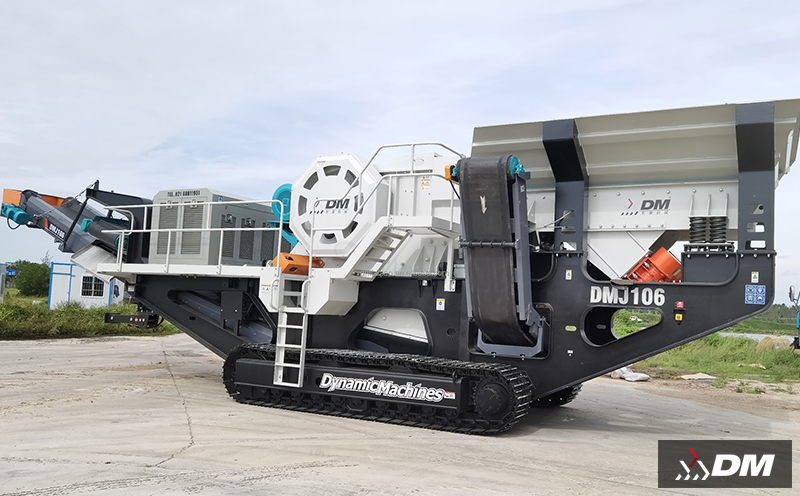
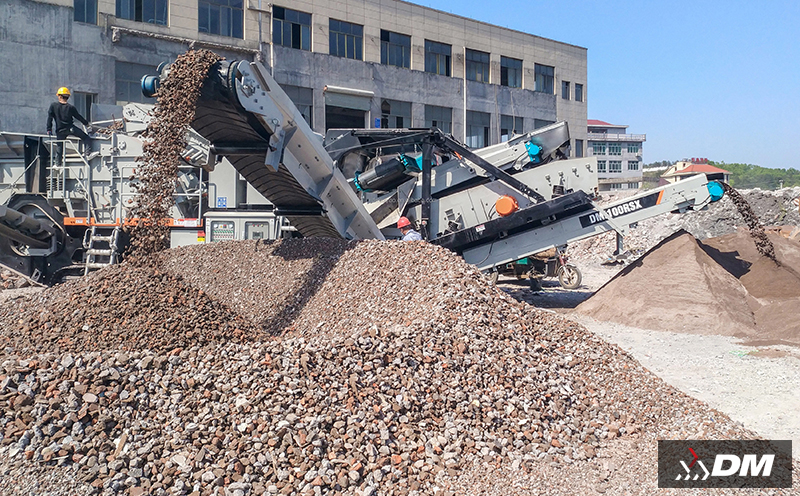
Mobile Crusher in Action - Recycling Construction Waste
With the continuous advancement of urban renewal, old district demolition and reconstruction, and engineering construction, construction waste has become an important issue for urban governance and green development. Traditional transportation and landfill methods are not only costly and land-intensive, but also prone to causing dust and environmental pollution. The popularization of mobile crushers is making on-site resource utilization of construction waste a mainstream solution.
In various demolition sites and construction sites, mobile crushers can be flexibly brought to the site and quickly put into operation, without the need for complex infrastructure and free from site restrictions. Integrating feeding, crushing, screening and conveying functions in one, the equipment can directly process mixed materials such as waste concrete, bricks, mortar and asphalt. Through high-efficiency crushing and impurity removal systems, it converts construction waste into recycled aggregates of different specifications, realizing the transformation of "waste into treasure".
Compared with fixed crushing production lines, mobile crushers have prominent advantages: flexible relocation and immediate production upon arrival, greatly reducing long-distance transportation of construction waste; integrated design enables quick installation and commissioning with high commissioning efficiency; equipped with dust removal, noise reduction and spray systems, the operation is more environmentally friendly and easily meets the environmental protection requirements of construction sites. The processed recycled aggregates can be directly used for road subbase, roadbed backfilling, brick making, recycled concrete, etc., which not only saves natural sand and gravel resources, but also significantly reduces engineering material costs.
From reduction and harmless treatment to resource utilization, mobile crushers provide an efficient, economical and environmentally friendly one-stop solution for construction waste treatment. It not only solves the problem of construction waste disposal, but also creates new resource value, helping green construction and low-carbon city development.
Under the general trend of construction waste resource utilization, mobile crushers are becoming core equipment for engineering construction, environmental protection disposal and renewable resource utilization, providing stable and reliable equipment support for the sustainable development of cities.
Get In Touch With Us