 English
 简体中文
简体中文
 عربي
عربي
 Русский
 Français
 Español
What is the best way to crusher concrete?
In the fields of urban construction, road renovation, and building demolition, concrete crusher is a fundamental and critical task. Whether it is the demolition of abandoned buildings or the renovation of old road surfaces, choosing the right crusher method is directly related to project efficiency, cost control, and environmental protection. Faced with different types of concrete structures and different operating scenarios, which method is the best choice?
 https://dongmeng-group.com/mobile_track_crushers_and_screen/
1. Key Considerations for Choosing a Crushing Method
Before determining a crushing plan, it is necessary to comprehensively evaluate the following core factors:
- Crushing scale: Is it large-scale building demolition, road renovation, or local repair?
- Environmental constraints: Is the construction site close to residential areas, hospitals, or sensitive buildings?
- Reinforcement content: Is the crushed object plain concrete or reinforced concrete?
- Resource utilization requirements: Is it necessary to recover recycled aggregates?
- Construction period requirements: Is it emergency rush repair or routine construction?
Based on the above factors, a variety of mature concrete crushing methods have been formed in global engineering practice, each with its applicable scenarios and unique advantages.
2. Detailed Explanation of Mainstream Concrete Crushing Methods
2.1 Mechanical Crushing Method: The Most Widely Used Main Solution
Mechanical crushing is a method of crushing concrete using impact force, compressive force, or shear force generated by crushing equipment, and it is currently the most widely used crushing method in the world.
Main equipment types:
- Jaw crusher: Crushes large concrete blocks into smaller particles through periodic extrusion of fixed and movable jaw plates. Suitable for primary crushing of concrete blocks, with large processing capacity and strong wear resistance.
- Impact crusher: Crushes concrete by impacting it with high-speed rotating hammers, causing it to collide with the impact plate and break. The finished product has a good particle shape, suitable for producing recycled aggregates.
- Impact hammer (crushing hammer): Installed on excavators, it crushes concrete through high-frequency impact force. Suitable for local demolition, foundation crushing, and reinforcement stripping.
Application scenarios:
- On-site crushing treatment of building demolition waste
- Resource recovery and utilization of waste concrete
- Preliminary disintegration of reinforced concrete
Advantages: High efficiency, strong adaptability, batch processing capability
Limitations: Large equipment investment, obvious noise and vibration
2.2 Resonance Rubblization Technology: The Preferred Solution for Road Renovation
Resonance rubblization is an efficient technology specially used for crushing old cement concrete pavement, originating in the United States in the 1980s. This technology uses high-frequency and low-amplitude vibration (frequency 42-46Hz, amplitude 10-20mm) to make concrete slabs resonate with crushing machinery, achieving the effect of "cracking without breaking".
Technical characteristics:
- After crushing, a unique double-layer structure is formed: the upper layer is a relatively loose crushed stone layer (particle size below 5cm), and the lower layer is an interlocked block stone layer
- The static resilient modulus of the crushed layer reaches 500-900MPa, which can be directly used as a base course
- High construction efficiency, up to 2500 square meters per day, and traffic can be opened on the same day
Application scenarios:
- "White to black" transformation of old cement concrete pavement
- Overhaul of high-grade highway pavement
- Renovation of urban roads with high requirements on the surrounding environment
Advantages: Eliminates reflective cracks, 100% material recycling, little impact on surrounding buildings, no need for outward transportation of waste
Limitations: High cost of special equipment, suitable for pavement-type structures
2.3 Multi-head Hammer Rubblization Technology: A Reliable Choice for Pavement Renovation
Multi-head hammer rubblization is another widely used technology for crushing old cement concrete pavement. It crushes concrete slabs into small pieces by impacting the pavement with multiple heavy hammers at a certain height and spacing.
Technical characteristics:
- Crushed particle size is controllable, meeting the requirements of subbase or base course
- Construction parameters (hammer drop height, spacing) can be adjusted according to on-site conditions
- The impact on structures such as bridges and culverts can be avoided by controlling construction parameters
Application scenarios:
- Overhaul of cement pavement of highways at all levels
- Concrete demolition projects with open sites
Advantages: Mature technology, fast construction speed, good crushing effect
Limitations: Relatively large vibration and noise, relatively obvious impact on the surrounding environment
2.4 Full-Depth Mobile Crushing In-Situ Cold Recycling Technology: An Innovative Green and Low-Carbon Solution
This is an integrated technology that crushes the entire thickness of old cement concrete pavement, adds regenerants, cement and other materials on-site, and directly mixes to form a new base course.
Process flow:
- Pre-crushing: Preliminary crushing of concrete slabs using slab breakers or multi-head hammers
- Primary crushing: First crushing with a full-depth mobile crusher to form coarse materials of about 10cm
- Secondary crushing: Second crushing, stripping cement mortar through impact crusher + kneading action to form recycled aggregates meeting gradation requirements
- Recycling mixing: Adding cement, regenerant, water, and mixing into cement-stabilized mixture on-site
- Compaction and forming: Forming a new base course through initial compaction, shaping, final compaction, and curing
Technical advantages:
- 100% complete utilization of old pavement materials, no need for outward transportation of waste
- The elevation rise of the pavement is reduced by about 2/3 compared with traditional schemes
- 15%-20% cost saving (compared with newly paved cement-stabilized base course of the same thickness)
- High construction efficiency, 3000-4000 square meters per working day
- Small vibration, low noise, less dust, little impact on the surrounding area
Application scenarios:
- Overhaul of national and provincial trunk highways
- Pavement improvement projects of rural highways
- Projects with high requirements on environmental protection and construction period
2.5 Static Crushing Technology: A Precision Solution Without Vibration and Noise
Static crushing technology is a method of filling drilled holes in concrete with mixed static crushing agent, and using the expansion pressure (up to 30-50MPa) generated by the hydration reaction of the crushing agent to "quietly" crack and crush concrete.
Technical principle:
- The crushing agent is mainly composed of calcium oxide, cement, gypsum, water reducer, etc. The hydration reaction generates calcium hydroxide, resulting in volume expansion
- Expansion pressure increases with the increase of calcium oxide content
- Drilling parameters (hole diameter, hole spacing, hole depth) directly affect the crushing effect
Application scenarios:
- Local demolition of concrete foundations
- Crushing operations in vibration-sensitive areas such as around ancient buildings, hospitals, and schools
- Renovation and repair of large-scale equipment foundations
Advantages: No vibration, no noise, no flying stones, high safety
Limitations: Slow crushing speed (usually 12-24 hours required), greatly affected by temperature, large drilling workload
2.6 Combined Crushing Technology: An Innovative Method for Efficient Treatment of Reinforced Concrete
For the crushing of reinforced concrete, researchers have proposed a combined method of abrasive water jet assisted mechanical crushing. This technology first uses abrasive water jet to pretreat reinforced concrete to form a damaged area around the reinforcement, and then uses mechanical hob to penetrate and crush.
Technical effects:
- Compared with pure mechanical crushing, the peak pressure of mechanical hob is reduced by 18.5%-21.7%
- The effective crushing volume of reinforced concrete is increased by 5.18-5.61 times
- The peak acoustic emission energy is increased by about 157%, and the crushing efficiency is significantly improved
Application prospects:
- Precision demolition of reinforced concrete structures
- Rapid repair of locally damaged concrete
3. Method Comparison and Selection Guide
To help global readers intuitively select a suitable crushing method, the following is a comparison from multiple dimensions:
| Crushing Method | Applicable Scenarios | Efficiency | Environmental Impact | Cost | Material Utilization Rate |
|---|---|---|---|---|---|
| Mechanical Crushing | Building demolition, concrete block treatment | High | Medium | Medium | Recyclable |
| Resonance Rubblization | Cement pavement renovation | High | Small | Medium | 100% Utilization |
| Multi-head Hammer Rubblization | Pavement overhaul | High | Medium | Medium | On-site Utilization |
| Full-Depth In-Situ Cold Recycling | Highway overhaul | High | Small | Low | 100% Utilization |
| Static Crushing | Local demolition in sensitive areas | Low | None | High | - |
| Combined Crushing | Reinforced concrete treatment | Medium | Small | Medium | - |
4. Conclusion: There is No Single Best, Only the Most Suitable
Based on the above analysis, there is no single answer to "the best method for crushing concrete", but it depends on specific engineering needs, environmental conditions, and resource utilization goals:
- For large-scale building demolition and concrete block treatment, mechanical crushing (jaw crusher + impact crusher combination) is the most efficient and cost-effective choice
- For old cement concrete pavement renovation, resonance rubblization or full-depth mobile crushing in-situ cold recycling technology can not only crush efficiently but also achieve 100% recycling of materials, which is a green and low-carbon preferred solution
- For local demolition in sensitive areas, although static crushing technology is slow, its advantages of no vibration and no noise are irreplaceable
- For efficient treatment of reinforced concrete, combined crushing technology represents the future development direction
Against the background of the global advocacy of circular economy and green development, concrete crushing is no longer just a matter of "demolition", but also a science of "utilization". Choosing crushing methods that can realize resource utilization and reduce environmental impact will be the mainstream direction of future engineering practice.
Mobile Crusher in Operation — Construction Waste Recycling
At demolition sites for urban renewal and reconstruction sites of old residential communities, the once mountainous piles of waste concrete and brick fragments are now "disappearing on-site" and "turning waste into treasure" through mobile crushers. This is not only a revolution in the treatment method of construction waste but also an important microcosm of the global circular economy development.
1. Challenges and Opportunities of Construction Waste
China's annual output of construction waste has exceeded 3 billion tons, but the resource utilization rate is less than 10%. The traditional mode of transportation and landfilling not only consumes a lot of land resources but also generates high transportation costs and environmental pollution. In an urban village renovation project in Baiyun District, Guangzhou, the cost of waste transportation accounted for a significant proportion of the total project cost.
Against this background, mobile crushers, with their unique advantages of flexible relocation, rapid commissioning, and on-site treatment, are becoming the core equipment for resource utilization of construction waste.
2. Core Operating Process of Mobile Crushers in Construction Waste Treatment
2.1 Source Entry: Equipment Directly to the Construction Site
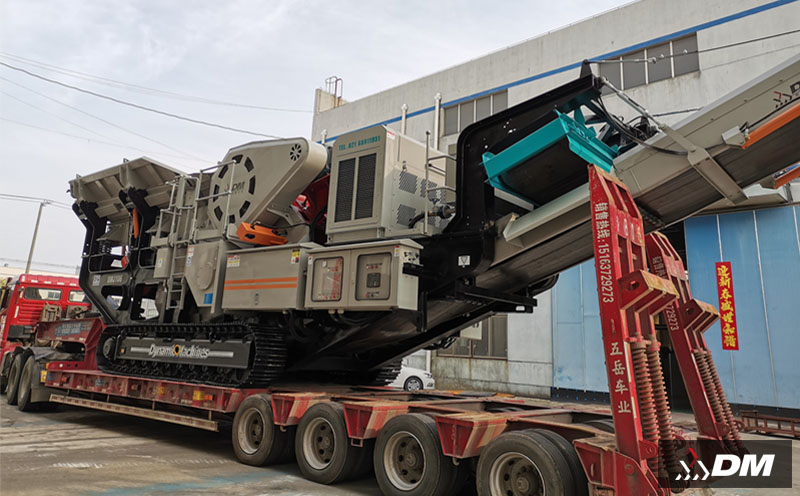
Mobile crushers adopt crawler chassis design and can directly drive into demolition sites. In multiple projects participated by Shanghai Dongmeng, crawler mobile crushing stations have realized "direct operation at the construction site" — eliminating the link of construction waste transportation and reducing pollution from the source.
2.2 Pre-screening: Removal of Impurity Soil
At the start of operation, materials first enter the mobile heavy-duty screen for pre-screening. This step separates the muck from the raw materials, and the undersize soil can be used for greening backfilling, reducing the subsequent treatment load. At the same time, manual or mechanical sorting removes large debris and hazardous waste to protect the crushing mainframe.
2.3 Crushing Core: From Large Blocks to Particles
The pre-screened concrete blocks and brick fragments enter the impact crusher or jaw crusher. Inside the impact crusher, the materials are instantly crushed by the impact of hammers driven by the high-speed rotating rotor. Taking Shanghai Dongmeng's crawler mobile impact crushing station as an example, it adopts heavy-duty rotor and large-capacity crushing chamber design, with large crushing ratio and cubic finished products, which is especially suitable for the crushing treatment of construction waste.
2.4 Iron Removal and Separation: Recovery of Reinforcement
When the crushed materials are discharged through the main belt, the magnetic separator above will sort out the reinforcement and iron blocks in the concrete. These waste metals can be directly recycled to create additional income. Shanghai Dongmeng's mobile crushing station is equipped with an iron removal device, which can efficiently process reinforced concrete with high anti-winding performance and high pass rate.
2.5 Fine Screening: Graded Discharge
The crushed materials enter the mobile screening station and are screened into recycled aggregates of different specifications. Taking a project in Tianjin as an example, the materials are divided into multiple specifications such as 0-12mm, 12-33mm, and 33-50mm. Shanghai Dongmeng's mobile screening station can operate independently or in linkage, with high screening efficiency and adaptability to various production lines.
2.6 Light Material Separation: Purity Improvement
For mixed materials such as decoration waste containing plastic, wood, and fabrics, a supporting negative pressure air separation system is required to separate light impurities according to the difference in specific gravity. Shanghai Dongmeng's light material separation system has high impurity removal efficiency, making recycled aggregates close to the quality of natural sand and gravel.
2.7 Finished Product Application: On-Site Utilization
The final output recycled aggregates can be directly applied to surrounding projects: 0-5mm fine materials are used for producing permeable bricks and slope protection bricks, and 10-30mm coarse materials are used for road cement-stabilized layers and pipeline backfilling. In the Guangzhou Mingke Park renovation project, most of the recycled aggregates are directly used as backfill materials in nearby construction sites, significantly reducing transportation costs.
3. Core Advantages of Mobile Crushers in Construction Waste Recycling
3.1 On-Site Treatment, Significant Cost Reduction
Under the traditional mode, construction waste needs to be transported to designated off-site locations for backfilling or disposal, resulting in high transportation costs. After the application of mobile crushing and screening equipment, construction waste can be treated inside the construction site, truly realizing on-site reduction and on-site utilization. Project contractors feedback: "It used to be time-consuming, labor-intensive and costly, but now it can be quickly converted into useful recycled aggregates."
3.2 Flexible Relocation, Crushing as Demolition Progresses
The crawler chassis design enables the equipment to be quickly and conveniently moved on-site, easily coping with complex terrain. Demolition operations are usually carried out "in zones and step by step", and mobile crushers can directly adjust their operating positions flexibly following the demolition areas, greatly reducing the time and cost of equipment transfer.
3.3 High Resource Utilization Rate, Significant Value
Through the optimization of the whole process of "crushing + magnetic separation + air separation + screening", Shanghai Dongmeng's comprehensive resource utilization rate of typical construction waste is as high as over 95%, among which the metal recovery rate is >90%, and the purity of the produced recycled aggregates is >98%, which can be directly sold as commercial aggregates.
3.4 Environmental Compliance, Green Construction
Urban construction projects are located in densely populated areas with extremely high environmental protection requirements. The high-pressure spray system equipped with mobile crushers can spray water in real-time during operation to effectively suppress dust pollution. Measures such as fully enclosed conveyor belts and low-noise design ensure clean production on-site.
4. Dongmeng Mobile Crushing Station: A Reliable Partner for Construction Waste Recycling
As a professional domestic provider of construction waste resource treatment equipment, Shanghai Dongmeng Road & Bridge Machinery Co., Ltd. focuses on the field of resource recycling and reuse of solid waste, integrating R&D, manufacturing, and sales. The company has passed the ISO9001 international quality system certification, owns dozens of invention patents, and is a "Specialized, Sophisticated, Unique and Novel" enterprise in Shanghai.
Core advantages of Shanghai Dongmeng's crawler mobile crushing station:
- Modular design: Weld-free structure with high fatigue strength and strong impact resistance
- Intelligent control: Wireless remote control device, allowing a single person to operate loading and unloading onto flatbed trailers
- Efficient iron removal: Built-in iron removal device, efficiently processing reinforced concrete
- Environmental protection configuration: Spray dust suppression system, meeting environmental protection requirements for urban construction
5. Conclusion
From mountainous "urban waste" to valuable "urban minerals", mobile crushers are playing a key role in this green transformation. Whether it is the renovation project of urban villages in Guangzhou or the 340,000 cubic meters of construction waste treatment project in Shuanggang Town, Tianjin, mobile crushing stations, with their unique advantages of flexibility and high efficiency, rapid commissioning, and on-site resource utilization, are converting waste concrete into valuable resources for urban construction.
For practitioners in the global construction waste treatment field, mobile crushers are not only essential equipment for environmental compliance but also a powerful assistant for cost reduction, efficiency improvement, and value creation. Choosing Shanghai Dongmeng means choosing a green solution of source reduction, on-site utilization, and high-value conversion.
Get In Touch With Us