 English
 简体中文
简体中文
 عربي
عربي
 Русский
 Français
 Español
What is the difference between jaw crusher and impact crusher?
Jaw crusher and impact crusher are the two most widely used crushing equipment in sand and aggregate production, mining crushing, construction waste treatment and other fields. Many users are often confused when choosing: what is the difference between them? How to choose? This article will systematically analyze the core differences between the two types of equipment to help you make a wise selection decision.
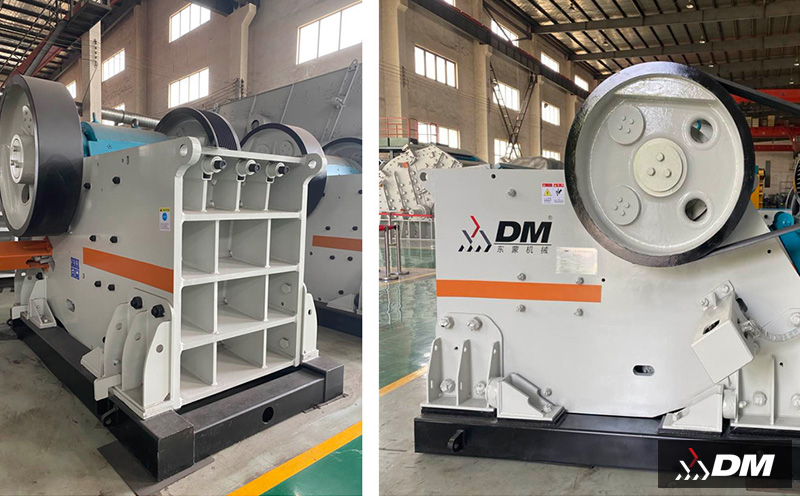
Structural Differences
Jaw Crusher
A jaw crusher is composed of a frame, fixed jaw plate, movable jaw plate, eccentric shaft, toggle plate, adjustment seat and other components. Its structure is relatively simple, and two jaw plates (fixed jaw plate and movable jaw plate) form a V-shaped crushing cavity. The movable jaw plate is suspended on the eccentric shaft, the lower end is supported by a toggle plate, and the movable jaw plate is driven to perform periodic reciprocating motion through the rotation of the eccentric shaft.
Impact Crusher
An impact crusher consists of a frame, rotor, blow bar, impact plate, adjustment device and other components. Its core is a high-speed rotating rotor with blow bars installed on it. Multiple impact plates are arranged around the rotor to form a multi-stage crushing cavity. The structure is relatively complex, but it has strong adaptability to materials.
Working Principle Differences
Jaw Crusher: Extrusion Crushing
The working principle of a jaw crusher is to extrude and bend materials through two jaw plates. When the movable jaw plate approaches the fixed jaw plate, the materials in the crushing cavity are crushed by huge extrusion and shear forces; when the movable jaw plate retreats, the crushed materials are discharged from the discharge port under the action of gravity.
This periodic movement of "crushing when approaching, discharging when moving away" is carried out continuously at a frequency of 200-400 times per minute, realizing intermittent crushing and discharging of materials.
Core features: mainly extrusion crushing, large crushing force, suitable for hard materials.
Impact Crusher: Impact Crushing
An impact crusher uses the high-speed impact principle to achieve crushing. The motor drives the rotor to rotate at a high speed, and the blow bars installed on the rotor throw the materials entering the crushing cavity to the impact plate at a high speed. The materials are crushed after a violent impact with the impact plate, and then rebound back to the blow bar action area, forming multiple cyclic impact crushing. At the same time, materials collide with each other to further refine.
Core features: mainly impact crushing, high crushing efficiency, good product particle shape.
Applicable Material Differences
| Comparison Item | Jaw Crusher | Impact Crusher |
| Applicable Hardness | High-hardness materials (granite, basalt, iron ore, etc.) | Medium-hardness materials (limestone, dolomite, gypsum, etc.) |
| Compressive Strength | ≤320MPa | ≤250MPa |
| Material Characteristics | Suitable for all kinds of hard and highly abrasive materials | Suitable for brittle, non-abrasive or low-abrasive materials |
| Moisture Content | Low requirements for moisture content | Easy to block when moisture content is too high |
Summary: Jaw crushers are good at processing high-hardness and high-abrasive materials; impact crushers are more suitable for medium-hardness and brittle materials, and have better crushing effects on soft materials.
Product Particle Size and Particle Shape Differences
Jaw Crusher
Discharge particle size: relatively coarse, usually used as primary crushing equipment, discharge particle size ranges from tens of millimeters to hundreds of millimeters
Particle shape characteristics: relatively high content of needle and flake particles, irregular particle shape
Application scope: as primary crushing, providing materials with appropriate particle size for subsequent fine crushing equipment
Impact Crusher
Discharge particle size: adjustable as needed, fine and uniform discharge particle size
Particle shape characteristics: cubic products, low content of needle and flake particles, excellent particle shape
Application scope: can directly produce high-quality finished aggregates, especially suitable for projects with strict particle shape requirements (such as highways, high-speed railways)
Role Differences in the Production Process
Jaw Crusher: First Choice for Primary Crushing
Jaw crushers are usually located in the first process of the production line, undertaking the task of primary crushing. It crushes large raw ores (with a diameter of more than 1 meter) after blasting to a particle size (about 100-300 mm) that can enter secondary crushing.
Typical configuration: jaw crusher + cone crusher + sand making machine
Impact Crusher: Secondary Fine Crushing or Single-stage Crushing
Impact crushers can be used as secondary crushing equipment (behind jaw crushers), or as single-stage crushing equipment to directly process raw materials in small-scale production lines. In the production of some medium-hardness materials (such as limestone), impact crushers can directly complete the crushing task from large raw materials to finished aggregates.
Typical configuration: jaw crusher + impact crusher (secondary crushing) or single-stage impact crusher
Performance and Operation Characteristics Comparison
| Comparison Item | Jaw Crusher | Impact Crusher |
| Crushing Ratio | 3-6 | 10-20, up to more than 40 |
| Processing Capacity | 1-1500 tons/hour | 30-800 tons/hour |
| Energy Consumption | Relatively high (unit energy consumption) | Relatively low (high crushing efficiency) |
| Wear Parts | Jaw plate (relatively long service life) | Blow bar, impact plate (high replacement frequency) |
| Maintenance Convenience | Simple structure, easy maintenance | Complex structure, slightly higher maintenance difficulty |
| Iron Protection | Vulnerable parts are easy to damage, manual handling required | Equipped with iron protection device (pull rod, hydraulic system) |
Application Scenario Selection Guide
Scenarios for Choosing a Jaw Crusher
Processing high-hardness materials (granite, basalt, iron ore, river pebbles, etc.)
Highly abrasive materials
As primary primary crushing equipment
Large-scale production line with complete subsequent fine crushing process
Pursuing equipment stability and maintenance convenience
Scenarios for Choosing an Impact Crusher
Processing medium-hardness materials (limestone, dolomite, gypsum, coal gangue, etc.)
Strict requirements for finished product particle shape (highways, high-speed railways, high-grade roads)
Low-abrasive materials
Small-scale production lines hoping to simplify the process (single-stage crushing)
Focusing on the quality of finished aggregates
Typical Combined Application
In actual production, jaw crushers and impact crushers are often used together to form an efficient production line:
Jaw crusher + impact crusher combination: the jaw crusher is responsible for primary crushing, crushing large raw materials to an appropriate particle size; the impact crusher is responsible for secondary fine crushing, producing finished aggregates with excellent particle shape. This combination not only exerts the ability of jaw crusher to process hard materials, but also utilizes the advantage of good discharge particle shape of impact crusher, which is a classic configuration for medium-hardness material production lines such as limestone and dolomite.
Jaw crusher + cone crusher combination: for high-hardness materials such as granite and basalt, cone crushers are usually used for secondary fine crushing after primary crushing by jaw crushers. Cone crushers adopt the lamination crushing principle, which has higher efficiency and longer service life of wear parts when processing high-hardness materials.
Selection Suggestions
When choosing a jaw crusher or an impact crusher, it is recommended to consider the following factors comprehensively:
1. Material characteristics: hardness, abrasiveness, moisture content, mud content
2. Finished product requirements: particle size range, particle shape requirements, gradation requirements
3. Process flow: primary crushing, secondary crushing or fine crushing? Is single-stage crushing required?
4. Investment budget: equipment procurement cost, operation and maintenance cost
5. Site conditions: space size, whether it is suitable for arranging multi-stage crushing
Conclusion
Jaw crushers and impact crushers have their own advantages, there is no absolute "good" or "bad", the key is whether they are suitable for your specific needs.
Jaw crusher is the "main force" in the field of primary crushing, known for its simple structure, reliable operation and strong adaptability, and is the first choice for primary crushing of high-hardness materials.
Impact crusher is an "expert" in high-quality aggregate production, known for its large crushing ratio and excellent product particle shape, and is an ideal choice for secondary fine crushing of medium-hardness materials.
In practical applications, they are often "partners" rather than "opponents". Understanding their respective characteristics and applicable scenarios can help you make the most reasonable selection decision based on your own material characteristics and finished product requirements, and build an efficient and economical crushing production line.
What is a jaw crusher used for?—Dongmeng Group
In many global industries such as mining, stone processing and construction waste treatment, jaw crushers, as the most classic and widely used crushing equipment, undertake an indispensable and important role. So, what exactly is a jaw crusher used for? This article will give you a comprehensive analysis.
Core Purpose: The Main Force of Primary Crushing Operations
The fundamental task of a jaw crusher is only one: to crush large raw ores and rocks after blasting or excavation from huge blocks with a diameter of more than 1 meter to an appropriate particle size that can enter secondary crushing equipment (such as cone crushers, impact crushers), usually 100-300 mm.
In the entire crushing production line, the jaw crusher is always located in the first process, undertaking the most arduous "primary crushing" task. It is like the "gate" of the entire production line, and all subsequent processes such as crushing, screening and sand making are based on the preliminary crushing completed by the jaw crusher.
Main Application Fields
1. Mining
In metal mines (iron, copper, gold, molybdenum, etc.) and non-metal mines (granite, basalt, limestone, etc.), jaw crushers are the starting point of the mineral processing process. It crushes large ores after blasting to a level acceptable for the grinding process, which is directly related to the production capacity and efficiency of the entire concentrator.
Typical applications:
Iron ore: primary crushing link of world-class iron mines such as Vale in Brazil and Rio Tinto in Australia
Copper ore: open-pit mines in major copper producing areas such as Chile and Peru
Gold ore: gold mines in South Africa, Ghana, Australia and other places
2. Sand and Aggregate Production
In the production of sand and aggregates for engineering such as highways, railways, water conservancy and construction, jaw crushers undertake the task of crushing natural rocks (granite, basalt, river pebbles, limestone, etc.) into processable stones. It is an indispensable primary crushing equipment for sand and stone production lines.
Typical applications:
Crushed stone for highway subgrade
Ballast for high-speed railway track bed
Aggregate for water conservancy dam concrete
Crushed stone raw materials for commercial concrete
3. Construction Waste Recycling
With the global emphasis on sustainable development, the resource utilization of construction wastes such as waste concrete and bricks has become an important direction. Jaw crushers can be used for the primary crushing of construction waste, crushing large waste concrete blocks and bricks to a particle size that can be further sorted and reused.
Advantages: jaw crusher has simple structure and strong adaptability, can handle construction waste containing steel bars and other debris, and is an important equipment for urban solid waste treatment.
4. Renewable Resources Recycling
Jaw crushers also play a unique role in the field of waste material recycling:
Waste glass crushing
Waste refractory material crushing
Primary crushing of industrial solid wastes such as slag and steel slag
Why Jaw Crushers Are Suitable for Primary Crushing
The reason why jaw crushers become the preferred equipment for global primary crushing operations stems from their unique design and working principle:
1. Strong Crushing Force
Jaw crushers use two jaw plates to extrude and bend materials, which can generate huge crushing force enough to cope with high-hardness and high-strength materials such as granite and basalt (compressive strength up to 320MPa).
2. Wide Feed Port
The feed port size of jaw crushers ranges from hundreds of millimeters to more than two meters, which can directly process large ores after blasting without pre-crushing.
3. Simple and Reliable Structure
Compared with other crushing equipment, jaw crushers have a relatively simple structure, few key components, stable and reliable operation, convenient maintenance, and can adapt to harsh working conditions such as mines and quarries.
4. Strong Continuous Operation Capability
Jaw crushers can operate continuously for 24 hours to meet the needs of large-scale production, and the operating rate is usually more than 85%.
Global Application Characteristics
The application of jaw crushers in different regions of the world shows their own characteristics:
Asia: infrastructure construction in China, India and Southeast Asian countries has driven the wide application of large jaw crushers. In countries along the Belt and Road, jaw crushers have become the core equipment for sand and aggregate production.
Africa: with the advancement of African infrastructure construction, jaw crushers play an important role in highway and railway projects in Kenya, Ethiopia, Tanzania and other countries; mineral countries such as South Africa and Zambia use them for mine primary crushing.
South America: copper mines in Chile and Peru, iron mines in Brazil, lithium mines in Argentina — jaw crushers are the key starting point of the mineral processing technology of these mining countries.
Europe and North America: focusing on environmental protection and efficient resource utilization, jaw crushers are widely used in construction waste regeneration, abandoned mine reclamation and other projects; at the same time, large jaw crushers still serve the production of existing mines.
Australia: as a global mining power, jaw crushers are widely used in the development of iron ore, bauxite, gold ore and other resources, and are the preferred equipment for primary crushing in large mines.
Unique Advantages of Jaw Crushers
Compared with other primary crushing equipment, jaw crushers have the following irreplaceable advantages:
| Advantages | Description |
| Strong Adaptability | Can process all kinds of materials from soft limestone to hard granite and basalt |
| Large Processing Capacity | Single machine processing capacity can reach more than 1500 tons/hour, meeting the needs of large-scale production |
| Stable Operation | Simple structure, low failure rate, suitable for long-time continuous operation |
| Convenient Maintenance | Convenient jaw plate replacement, small daily maintenance workload |
| High Cost Performance | Relatively low equipment procurement cost, short investment return cycle |
Technological Development of Jaw Crushers
With the continuous improvement of global mining and construction industry requirements for efficiency, energy consumption and intelligence, jaw crushers are also continuously evolving:
Deep cavity design: optimize the crushing cavity shape, improve crushing efficiency and reduce liner wear
Increased inertia force: adopt flywheels with larger mass to achieve more stable crushing force output
Hydraulic adjustment: hydraulic discharge port adjustment system to achieve fast and accurate particle size control
Intelligent control: integrated online monitoring system to monitor equipment operation status in real time
Energy saving and consumption reduction: optimize the transmission system to reduce unit energy consumption
Conclusion
As the name suggests, a jaw crusher is a device that uses two jaw plates to crush materials by extrusion. But in modern industrial production, its value is far more than that — it is the "first gateway" of mining, the "starting point" of sand and aggregate production lines, and the "pioneer" of construction waste recycling.
From deep well mines to open-pit mines, from giant hydropower stations in high mountains and valleys to highways crossing mountains and mountains, from high-rise urban buildings to busy ports and docks, jaw crushers silently convert natural rocks into materials supporting modern civilization. With the continuous advancement of global infrastructure construction and the in-depth development of mineral resources, jaw crushers will continue to play an irreplaceable role in the field of primary crushing.
Get In Touch With Us