 English
 简体中文
简体中文
 عربي
عربي
 Русский
 Français
 Español
What are the Differences Between Crushers and Screens?
In sectors like mining, building materials, and metallurgy, crusher and screen serve as pivotal equipment in material processing workflows. Yet, they differ substantially in core functions, operational mechanisms, and practical applications. This article dissects the distinctions between these two devices from three perspectives: fundamental definitions, working principles, and application scenarios.
I. Contrasts in Core Definitions and Functions
Crusher: Its primary purpose is "volume reduction". By means of extrusion, impact, grinding, and other mechanical processes, it breaks down bulky, irregular raw materials into small-particle-size products that meet production specifications, addressing the issue of "oversized materials unfit for direct use". Common variants include jaw crushers, cone crushers, and hammer crushers.
Screen: The core function lies in "material classification". It separates mixed material batches into finished or semi-finished products of distinct sizes based on particle dimensions, resolving the problem of "uneven particle sizes requiring sorting". Typical types are vibrating screens, trommel screens, and linear screens.
II. Variations in Working Principles
1. Operational Principle of Crushers
Crushers apply mechanical force to process materials: Jaw crushers compress materials between a movable jaw plate and a fixed jaw plate; hammer crushers shatter materials via high-speed rotating hammers; cone crushers crush materials through the combined action of extrusion and grinding between a moving cone and a fixed cone. The core objective is to alter the physical dimensions of materials, which falls under the category of "destructive processing".
2. Operational Principle of Screens
Screens leverage the vibration, rotation, or linear motion of their screen surfaces to separate materials. Particles that match the screen aperture size pass through the screen, while oversized particles remain on the surface, achieving effective classification. The key lies in sorting materials by "screen hole size" without altering the particle size itself, which is defined as "screening separation".
III. Differences in Application Scenarios and Process Positions
Within material processing lines, the usage sequence and application scenarios of crushers and screens are clearly demarcated:
- Crushers are typically deployed at the initial stage of material processing: When raw materials (e.g., ore, construction waste) are too large, they are first crushed to a basic particle size before proceeding to subsequent procedures.
- Screens can be installed both before and after crushers: Placed upstream, they sift out fine materials that do not require crushing, reducing the workload of crushers; positioned downstream, they classify the crushed mixture to produce finished products of varying specifications.
IV. Comparative Summary
In simple terms, a crusher "reduces large materials to small ones", with its core role being particle size reduction; a screen "separates materials by size", focusing on material classification. These two devices are often used in tandem to achieve refined material processing, making them indispensable in industrial material treatment operations.
The Roles of Crushers and Screens in Solid Waste Treatment
Solid waste treatment is a critical component of environmental protection and resource recycling, encompassing domestic waste, construction waste, industrial residue, electronic waste, and more. As core equipment in solid waste treatment lines, crushers and screens are responsible for "volume reduction and crushing" and "classification and sorting" respectively. Their coordinated operation significantly enhances solid waste treatment efficiency and resource recovery rates. Notably, the specialized screening equipment developed by Dongmeng Group offers a high-efficiency solution for municipal solid waste treatment.
I. Core Functions of Crushers in Solid Waste Treatment
Crushers use mechanical force to break large, irregular solid waste into small-particle materials, laying the groundwork for subsequent treatment steps. Their specific roles are as follows:
- Volume reduction and minimization: Dramatically reduce the volume of solid waste. For instance, crushing concrete blocks and scrap steel from construction waste can cut their volume by 30%-70%, lowering transportation and storage costs while reducing landfill space requirements.
- Boost subsequent treatment efficiency: Large solid waste is challenging to directly sort, incinerate, or recycle. After crushing, materials achieve uniform particle sizes, facilitating sorting processes like screening, magnetic separation, and air separation. It also enhances combustion completeness during incineration and fermentation efficiency in composting.
- Resource pretreatment: For recyclable solid waste (e.g., waste plastic, scrap metal, waste wood), crushing breaks material bonding, separating different components to enable recycling. For example, crushing waste home appliance casings allows separation of plastic and metal parts.
- Support harmless treatment: For solid waste containing hazardous substances, crushing enables full contact between detoxification agents and materials, improving the efficacy of solidification/stabilization treatments.
II. Core Functions of Screens in Solid Waste Treatment
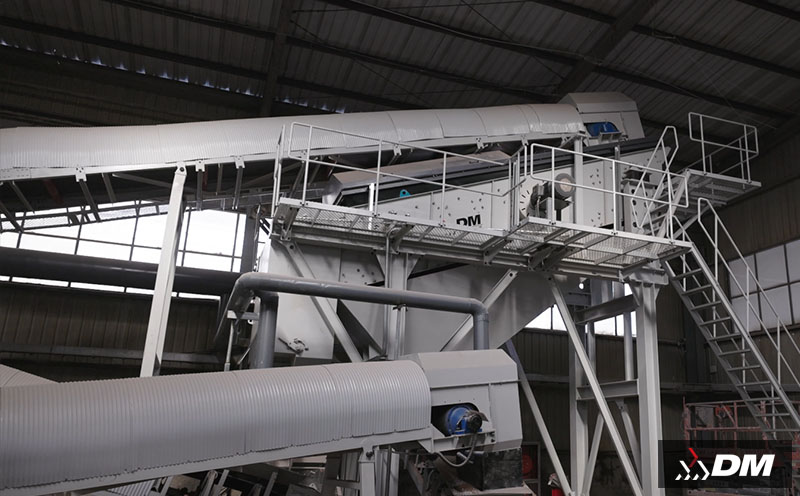
Screens separate mixed solid waste into categories based on particle size and shape through screen surface classification, acting as key equipment for solid waste "sorting and purification". Targeting the pain points of municipal solid waste—such as high light material content and frequent screen clogging—Dongmeng Group has developed a specialized high-frequency composite screen. This equipment has become the preferred choice for municipal solid waste screening, maximizing the core functions of screens. Its specific advantages include:
- Material classification and sorting: Separate crushed mixed solid waste by particle size. For example, screening construction waste to extract fine aggregates (usable for brick-making), coarse aggregates (suitable for roadbed backfilling), and impurities (e.g., plastic bags, steel bars) enables categorized treatment of different materials. With its high vibration frequency, Dongmeng Group's high-frequency composite screen accelerates material classification, significantly improving sorting efficiency.
- Impurity removal and quality improvement: In resource recovery, screens filter out small impurities (e.g., soil, dust) from solid waste, increasing the purity of recyclable materials (e.g., scrap metal, waste plastic) and boosting their recycling value. The high-frequency composite screen adopts a wear-resistant punched plate and screen bar design, ensuring durability and a long service life. Most importantly, it fundamentally resolves screen clogging caused by high light material content in municipal solid waste, guaranteeing continuous operation.
- Optimize process compatibility: Different solid waste treatment processes have specific particle size requirements. Screens can filter out materials that meet process standards (e.g., 80mm or smaller for incinerators, 20mm or smaller for fertilizer production), preventing unqualified materials from compromising treatment outcomes. Dongmeng Group's high-frequency composite screen features a simple structure, easy maintenance, and high output, making it suitable for large-scale solid waste treatment lines.
- Pre-process screening: Installing screens before crushing processes sifts out fine-grained solid waste that does not need crushing, reducing crusher load, energy consumption, and equipment wear.
III. Synergistic Value of Crushers and Screens in Solid Waste Treatment
In practical solid waste treatment lines, crushers and screens are not used independently; instead, they form a closed-loop workflow of "screening - crushing - re-screening":
1. Raw solid waste undergoes preliminary screening using equipment like Dongmeng Group's high-frequency composite screen. Fine materials are directly sent to subsequent processes, while coarse materials are transferred to crushers;
2. After coarse materials are crushed to the preset particle size, they are screened again for classification;
3. Classified materials of different particle sizes are directed to resource recovery, incineration, landfill, or composting processes accordingly.
This collaborative model not only cuts equipment energy consumption and operational costs but also maximizes the reduction, harmlessness, and recycling of solid waste. The application of Dongmeng Group's high-frequency composite screen further enhances the stability and efficiency of the screening process, making it a core component of modern large-scale solid waste treatment projects.
IV. Conclusion
Crushers act as "volume reduction tools" in solid waste treatment, tackling the challenge of processing oversized solid waste; screens serve as "sorting managers", enabling precise material classification and purification. Among these, Dongmeng Group's high-frequency composite screen—designed for the unique characteristics of municipal solid waste—stands out as an upgraded screening solution, boasting high vibration frequency, anti-clogging performance, large output, and easy maintenance. Together, crushers, screens (and specialized screening equipment) form the core pretreatment system for solid waste treatment, serving as key devices driving the shift from "harmless disposal" to "resource utilization" of solid waste.

Get In Touch With Us