 English
 简体中文
简体中文
 عربي
عربي
 Русский
 Français
 Español
500 Ton/Hour Mobile Crusher - Applications & Production Calculation
Suitable Applications & Production Calculation Methods
The 500-tonne-per-hour mobile crusher, leveraging its advantages of high output and flexible mobility, is suitable for various large-scale material crushing scenarios. It not only solves site restriction issues but also meets high-efficiency production needs, mainly applicable to the following fields:
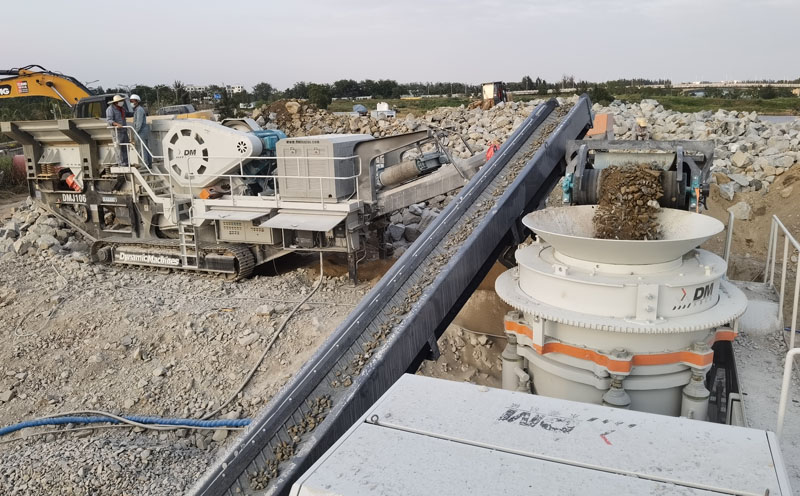
1. Construction Waste Treatment
Urban renewal, road renovation, building demolition and other projects generate a large amount of concrete blocks, waste bricks, reinforced construction debris and other materials. This capacity mobile crusher can operate directly at the construction site.
- Models equipped with hammer crushing configurations efficiently handle steel-free concrete pavement fragments
- Combinations of mobile jaw crushers and mobile impact crushers effectively process reinforced construction waste with good iron removal performance
- Crushed finished products can be used as recycled aggregates for concrete mixing, construction brick production or road base paving
- Realizes on-site resource utilization of construction waste while reducing transportation costs and environmental pollution
2. Large-Scale Mine Mining
It is highly practical in large-scale mining projects of various ores such as granite, basalt and limestone.
- Tracked models, with strong grip and remote control operation, adapt to harsh mining environments like rugged terrain and steep slopes
- Enables direct crushing operations at the ore face, eliminating long-distance transportation of ores to fixed crushing stations
- Mobile cone crusher configurations recommended for high-hardness materials like granite
- Mobile hammer or impact crushers for medium-low hardness ores such as limestone
3. Road and Infrastructure Engineering
Large-scale infrastructure projects such as highways, railways, bridges and water conservancy dams have enormous demand for sand and gravel aggregates. Construction sites are often scattered with variable conditions.
- Flexibly moves with construction progress to timely provide qualified sand and gravel materials
- Crushes on-site mountain rocks, river pebbles and other raw materials for subgrade filling and concrete pouring
- Significantly reduces cost and transportation time of purchased sand and gravel
- Ensures project progress with on-demand material supply
4. Sand and Gravel Building Materials Production
For professional sand and gravel factories needing to address scattered raw material sources or temporary production increase demands, this equipment is an ideal choice.
- Adapts to various medium-low hardness materials including limestone, gneiss and bluestone
- Some models equipped with sand-making modules for finished sand production meeting construction standards
- Quick transfer to raw material producing areas for urgent market demand
- No complex infrastructure required, enabling short-time commissioning
5. Industrial Solid Waste Treatment
Industries such as metallurgy, coal and chemical engineering generate a large amount of industrial waste residue, including gangue, slag and steel slag.
- Specifically designed for handling various industrial solid wastes
- Crushes low compressive strength materials like gangue into fuel or building materials
- Processed slag and steel slag usable for cement admixture or road base materials
- Helps enterprises realize reduction and resource utilization of industrial solid waste
The production capacity of a 500-tonne-per-hour mobile crusher is mainly calculated by the ratio of the actual weight of crushed materials (tonnes) to the operating time (hours). The industry-universal formula is: Actual Hourly Output = Total Weight of Crushed Materials ÷ Effective Operating Time. Detailed calculation logic and influencing factors are as follows:
1. Core Calculation Logic
- Basic Formula: Actual Hourly Output (t/h) = Total Weight of Crushed Materials (t) ÷ Effective Operating Time (h). For example, if 4,000 tonnes of materials are actually crushed within 8 hours, the actual output is 4,000 ÷ 8 = 500 t/h, meeting the equipment's marked capacity.
- Theoretical Output Reference: The "500 tonnes per hour" marked by manufacturers is mostly a theoretical value calculated under standard conditions (e.g., limestone as material, feed particle size ≤ 500mm, discharge particle size meeting conventional requirements, continuous full-load operation). Formula: Theoretical Output = Equipment Rated Processing Capacity (converted by parameters such as rotation speed and cavity volume) × Material Bulk Density Coefficient.
2. Key Factors Affecting Production Calculation
- Material Characteristics: Higher hardness and moisture content (over 10%) lead to lower actual output; materials with high bulk density result in slightly higher output than light materials.
- Feeding Conditions: Excessively large feed particle size or uneven particles reduce crushing efficiency; discontinuous feeding shortens effective operating time.
- Discharge Requirements: Finer discharge particle size requires more crushing stages, resulting in lower unit-time processing capacity; coarser discharge corresponds to higher output.
- Equipment Status and Operation: Equipment wear reduces crushing efficiency; improper operation interrupts operations and shortens effective working time.
3. Notes on Calculation in Actual Production
- Unified Statistical Standard: Total material weight should be counted based on "weight of crushed finished materials" (deducting impurities and dust loss) to avoid errors.
- Elimination of Non-Effective Time: Operating time should exclude non-production time such as equipment maintenance, feeding waiting and blockage cleaning.
- Batch Calibration: Adopt batch statistics (total daily/weekly output ÷ corresponding total effective operating time) for more accurate real capacity assessment.
Get In Touch With Us