 English
 简体中文
简体中文
 عربي
عربي
 Русский
 Français
 Español
What is a vibrating screen? Definition, Working Principle, and Industrial Uses
In material processing for mining, quarrying, construction materials, chemical engineering and other industries, there is a critical process – screening. The core equipment that performs this task is the vibrating screen.
1. Definition of a Vibrating Screen
A vibrating screen is a mechanical separation device that uses vibration to classify and screen materials. In simple terms, it acts as an industrial sieve. Through continuous and rapid vibration, it separates mixed granular materials into different sizes, and can also perform dewatering, desliming and medium removal.
A vibrating screen mainly consists of two parts: the screen box (with screen mesh) and the vibrator. The motor drives the vibrator to generate exciting force, making the screen box vibrate regularly. Materials on the screen surface are continuously thrown up and fall down. Small particles pass through the screen openings as undersize products, while large particles move forward along the screen surface as oversize products, achieving classification.
2. Working Principle of a Vibrating Screen
The core component of a vibrating screen is the vibrator. Taking a common circular vibrating screen as an example, the motor drives the vibrator through a coupling, making the eccentric blocks inside rotate at high speed and generate strong centrifugal force. This force drives the screen box to perform continuous circular motion.
Driven by vibration, materials on the inclined screen surface are thrown continuously. When suspended, the material layer loosens and stratifies. When falling back, particles smaller than the screen openings pass through the screen. Through this repeated cycle of throwing, stratifying, screening and moving forward, materials of different sizes are accurately separated.
3. Main Types of Vibrating Screens
According to the movement trajectory of materials on the screen surface, vibrating screens are divided into three main types:
| Type | Motion Trajectory | Features and Applications |
| Circular Vibrating Screen | Circular or elliptical | Simple structure, durable, high screening efficiency, widely used for aggregate classification in quarries and mines |
| Linear Vibrating Screen | Linear reciprocating motion | High efficiency, good dewatering performance, suitable for coal dewatering and fine material classification |
| High-Frequency Vibrating Screen | High-frequency linear motion | Used for fine material separation and dewatering, improves screening efficiency of fine particles |
In addition, according to application scenarios, they can be divided into heavy-duty mining vibrating screens for large ore processing and light-duty fine vibrating screens for powder or fine particle materials.
4. Core Advantages of Vibrating Screens
- High screening efficiency: strong vibration fully stratifies materials, increasing the chance for small particles to pass through the screen
- Large processing capacity: continuous handling of large volumes for mass production
- Sturdy and durable: modern designs with ring-groove rivets and non-welded side plates withstand long-term high-load operation
- Wide application: suitable for hard rock, coal, ore, construction waste recycling and chemical raw material classification
- Convenient maintenance: new models with modular vibrators and hydraulic lifting screen boxes reduce screen change and inspection time
5. Main Application Fields
Vibrating screens are core equipment in crushing and screening production lines, widely used in:
- Mining and metallurgy: ore classification and pre-screening before beneficiation
- Quarries and building materials: aggregate classification to produce finished products of different sizes
- Coal industry: coal classification, dewatering, desliming and medium removal
- Construction waste recycling: screening crushed concrete and bricks into renewable aggregates
- Chemicals and food: particle size classification of raw materials and finished powder
6. Summary
A vibrating screen is a high-efficiency screening device that uses exciting force to drive regular vibration of the screen surface, accurately classifying mixed materials by particle size.
Whether in stationary production lines or mobile screening plants requiring frequent relocation, vibrating screens act as quality gatekeepers. Shanghai Dongmeng YK series circular vibrating screens adopt advanced designs such as flexible tire coupling and oil-lubricated large-clearance bearings, featuring stable operation, sturdiness and high screening efficiency. They are widely used in global mining, quarrying and construction waste treatment projects. For a customized vibrating screen solution based on your material characteristics and capacity requirements, please contact Dongmeng for professional support.
Comprehensive Analysis of Working Principle and Common Types of Vibrating Screens
Vibrating screens are core classification equipment in mining, building materials, sand and gravel, chemical engineering and other industries. They achieve precise particle size separation through mechanical vibration, directly determining production line efficiency and finished product quality. As a global manufacturer of crushing and screening equipment, Shanghai Dongmeng, with its YK series circular vibrating screens, integrates advanced technology and durable structures to adapt to various working conditions worldwide. This article provides a comprehensive analysis of principles, types, selection and product advantages for global users.
1. Core Working Principle of Vibrating Screens
The essence of a vibrating screen is a dynamic process: exciting force driving, material throwing and stratifying, particle passing and classifying.
- Power generation: the motor drives the vibrator (eccentric block or shaft) through a coupling to rotate at high speed, generating periodic centrifugal exciting force that vibrates the screen box and surface synchronously
- Material movement: the screen surface is usually inclined at 15°–20°. Materials are continuously thrown and fall under vibration. When thrown, materials loosen and stratify; when falling, fine particles pass through the screen openings while coarse particles slide along the surface
- Key parameters: amplitude (1–5mm), frequency (800–1200r/min) and inclination directly affect efficiency. Small amplitude, high frequency and large inclination improve capacity and classification accuracy
2. Global Mainstream Vibrating Screen Types (by Motion Trajectory)
2.1 Circular Vibrating Screen (Single-axis Excitation)
- Principle: single-axis eccentric block rotation creates circular or near-circular motion, strong material dispersion
- Features: strong exciting force, simple structure, durable, anti-clogging, large processing capacity
- Application: primary and secondary screening in mines, aggregate classification, mainstream in quarries and beneficiation plants
- Dongmeng representative: YK series circular vibrating screens with block eccentricity and oil lubrication, suitable for global high-load conditions
2.2 Linear Vibrating Screen (Double-axis Excitation)
- Principle: double-axis eccentric blocks rotate synchronously in opposite directions, vertical forces superpose and horizontal forces cancel, creating linear reciprocating motion
- Features: linear material movement, high screening efficiency, ideal for fine particles and dewatering
- Application: manufactured sand classification, coal dewatering, chemical fine powder screening
2.3 Elliptical Vibrating Screen (Three-axis Excitation)
- Principle: three-axis eccentric block combination forms elliptical trajectory, combining dispersion of circular motion and efficiency of linear motion
- Features: screening efficiency increased by over 20%, suitable for wet and sticky materials
- Application: difficult-to-screen materials, high-humidity ore, tailings dry discharge
2.4 High-Frequency Vibrating Screen
- Principle: frequency 1000–3000r/min, small amplitude, high-frequency micro-movement of materials
- Features: high precision for fine powder, anti-clogging, suitable for particles finer than 300 mesh
- Application: quartz sand, abrasive, pharmaceutical powder fine classification
3. Common Types by Structure and Application
- Multi-layer vibrating screen: 2–4 layers for simultaneous classification into multiple sizes, standard in Dongmeng YK series
- Heavy-duty vibrating screen: thickened steel plate, high-strength structure for large hard rock and highly abrasive ore
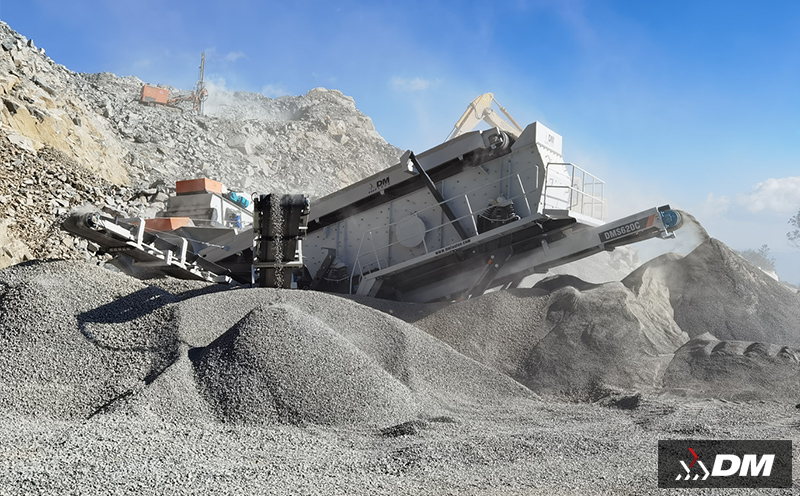
- Mobile vibrating screen: integrated in mobile crushing plants, no foundation needed, fast relocation, suitable for global scattered sites and construction waste treatment
- Dewatering vibrating screen: low inclination, high frequency, for sand and coal dewatering and desliming
4. Core Advantages of Shanghai Dongmeng YK Series Vibrating Screens
- Sturdy structure: ring-groove rivet connection and flexible tire coupling, impact-resistant, long service life, adapts to high temperature, cold and high-altitude conditions
- High screening efficiency: small amplitude, high frequency, large inclination design, 15% higher efficiency than industry average, capacity 10–1000t/h
- Easy maintenance: oil-lubricated large-clearance bearings extend maintenance cycle by 50%, low noise, low failure rate
- Global adaptability: modular design, standard container shipping, multi-language operation, global spare parts network with 12-hour response
5. Key Selection Criteria
- Material characteristics: circular screens for hard rock and large pieces; linear screens for fine particles and dewatering; elliptical screens for wet and sticky materials
- Capacity demand: YK-1230/YK-1548 for small and medium-sized projects; YK-2160/YK-3680 for large mines
- Working conditions: stationary type for fixed production lines; mobile type for on-site operations
Summary
Vibrating screens are based on the principle of vibration screening. Four types – circular, linear, elliptical and high-frequency – cover global application scenarios. Shanghai Dongmeng YK series circular vibrating screens are preferred in mining, sand and gravel, and building materials due to sturdy structure, high efficiency and global service. Whether in Southeast Asia, Africa, Europe or Latin America, Dongmeng provides vibrating screen solutions adapted to local materials and conditions, ensuring efficient production, stable operation and long-term profitability.
Get In Touch With Us