 English
 简体中文
简体中文
 عربي
عربي
 Русский
 Français
 Español
How to adjust the discharge gap of the impact crusher
In aggregate production, stone crushing and construction waste recycling industries, the impact crusher is widely used for medium‑crushing and shaping operations. The discharge gap directly controls finished particle size, product grain shape and actual output of the machine. Incorrect gap setting may cause oversized finished materials, low production efficiency and excessive wear of wearing parts. As a professional impact crusher factory, Shanghai Dongmeng shares standard adjustment procedures and key notes for users to correctly set the gap of impact crusher.
Pre‑adjustment preparation work
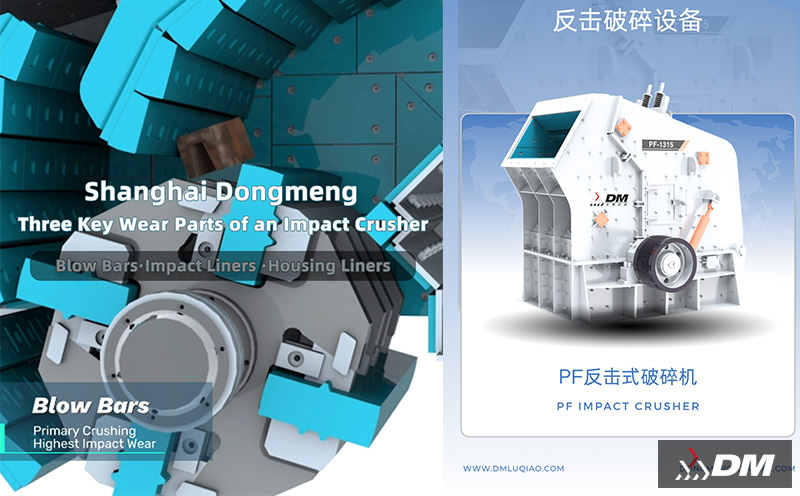
Before adjusting the discharge gap of the impact crusher, you must shut down the equipment and cut off power supply to ensure operation safety. Wait until the rotor stops rotating completely. Clean up residual stones and debris inside the crushing chamber. Inspect the wear condition of impact plates, blow bars and liner plates. Severely worn components shall be replaced first; otherwise the adjustment value will be inaccurate. Confirm the adjusting mechanism including hydraulic cylinder or screw adjusting assembly is in normal working condition.
Main methods for adjusting discharge gap
Most impact crusher models adopt hydraulic adjustment or screw manual adjustment. For hydraulic‑type machines, operate the hydraulic system to push the impact frame, change the distance between impact plate and blow bar, so as to modify discharge gap. For screw‑adjustment versions, turn the adjusting screw to move the impact plate forward or backward. When the gap becomes smaller, finished material will be finer; when the gap becomes larger, output particle size increases. Operators should refer to the factory technical manual and do not exceed the allowable adjusting range of the impact crusher.
Test run and verification after adjustment
After completing gap adjustment, close the crushing chamber protective cover. Start the impact crusher for no‑load test run, check for abnormal vibration and noise. Then carry out small‑volume feeding test, sample finished products to detect particle size. If the particle size still fails to meet requirements, fine‑tune the gap again. Re‑check bolt tightening status after each adjustment to prevent loose parts during high‑speed operation.
Frequent problems in gap adjustment
Long‑term wear of blow bars and impact plates will change the actual discharge gap of the impact crusher, even if the adjusting screw position remains unchanged. Only relying on scale reading is not enough; real‑product sampling inspection is necessary. Never adjust the gap while the crusher is running. If unbreakable materials enter the chamber, stop feeding and clear blockages before making any parameter modification.
Routine maintenance matched with gap adjustment
Regularly inspect impact plates, blow bars, locking parts and adjusting components of the impact crusher. Timely replace heavily worn wearing parts to keep the discharge gap stable. Record adjustment parameters and wearing‑part replacement conditions for later reference. Good daily maintenance can reduce frequent repeated adjustment work.
Technical support from impact crusher factory Dongmeng
As a reliable impact crusher factory, Shanghai Dongmeng provides complete technical manuals, installation guidance and genuine spare‑parts for global customers. Our engineers offer professional suggestions on discharge‑gap setting according to raw material hardness, production capacity and finished‑size demands. Correct adjustment and maintenance help the impact crusher keep high‑efficiency operation, reduce failure rate and cut comprehensive operating costs.
Get In Touch With Us